
Why Manufacturing Month-End Close Always Comes Down to the Same Three Accounts
GRNI, WIP, and inventory variance eat most of every close, and it's rarely because the accounting is hard. Here's where those differences actually come from, and when reconciliation is worth automating.
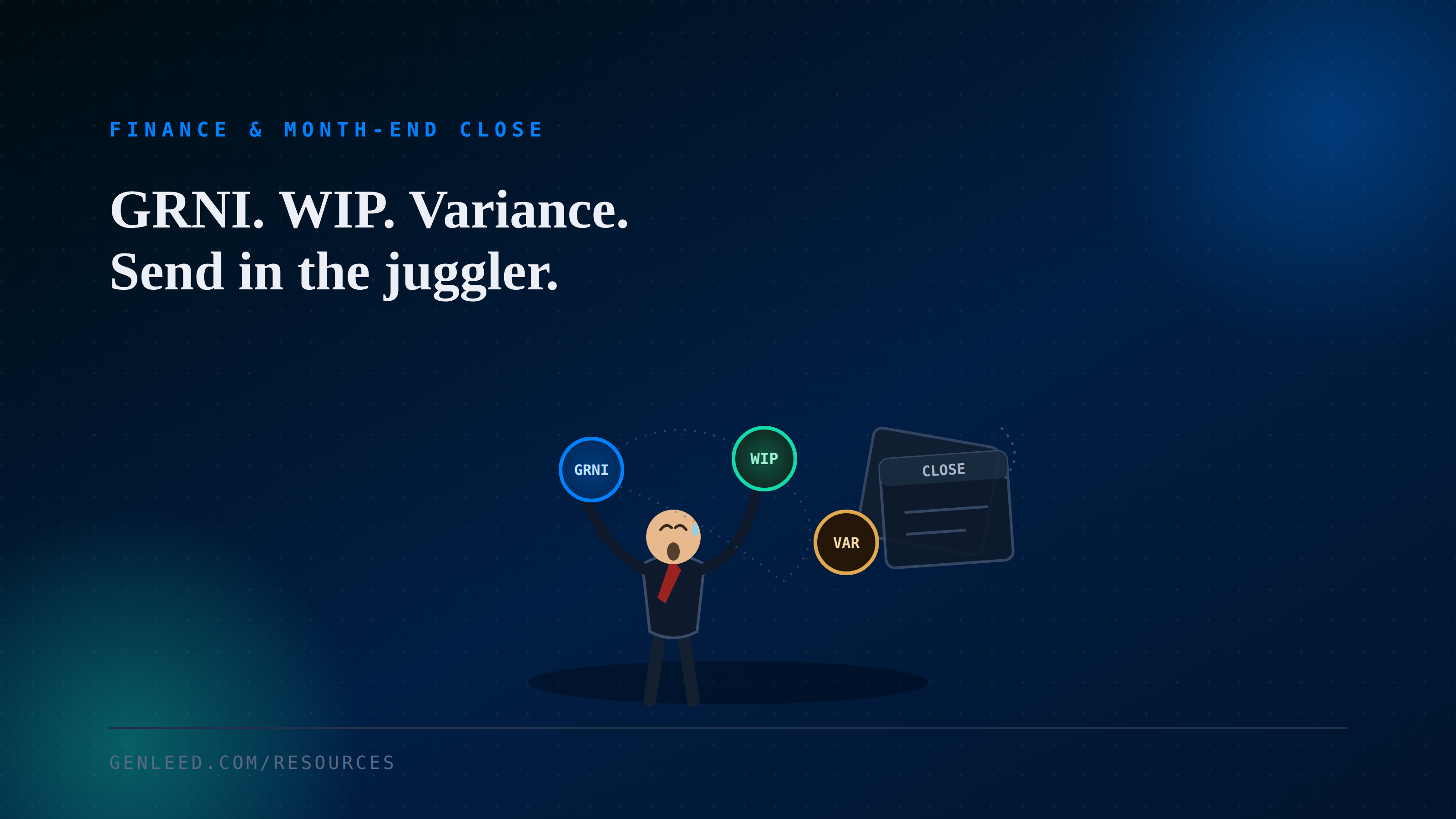
Ask a manufacturing controller which three accounts eat most of the close and the answer is almost always the same: GRNI, work in process, and inventory variance. Not because these accounts are inherently hard, just because they're where receiving, production, and purchasing data all meet, and nobody's daily job is to keep that meeting point clean.
Why these three accounts specifically
Each one collects a different kind of mismatch that builds up quietly until someone has to reconcile it.
- Goods received not invoiced (GRNI) piles up when receiving records a quantity that doesn't match the invoice, or the invoice simply hasn't arrived yet, and nobody follows up until close.
- Work in process drifts when labor and material postings lag actual production, or when standard cost variances accumulate for weeks before anyone reviews them.
- Inventory variance grows from cycle count adjustments, scrap that wasn't booked when it happened, or transactions posted against the wrong location or cost center.
Why it happens every single month
These accounts sit at the point where receiving, production, and purchasing systems hand off to each other, and none of those systems are really designed to reconcile against the others automatically. Most days, nobody's job is to keep them clean. Somebody's job is only to close them.
Where to look before automating the close
Before adding a reconciliation tool, it's worth understanding where the differences actually come from.
- Pull adjusting entries for these accounts over the last three to six months and check whether the same root causes keep repeating.
- Look at how old the oldest open GRNI or WIP items really are, an aging view, not just the balance at close.
- Check whether receiving, invoicing, and production transactions are timestamped consistently enough to trace a discrepancy back to where it started.
- Ask whether anyone reviews these accounts between closes, or only when the close forces the question.
Where automation helps, and where it doesn't
When it's a timing or process fix
If most items turn out to be ordinary timing differences, an invoice that simply hadn't arrived yet, a receipt posted a day early, the fix is usually a mid-month review habit, not new software. Catching these weekly instead of monthly tends to shrink the list on its own.
When it's worth automating
If the volume is genuinely too high to review by hand, hundreds of receipts and invoices that need matching against each other every month, that's a fair case for rule-based matching: flagging only the differences that fall outside a normal range instead of asking someone to check every line. It's a matching problem, not a judgment problem, which is exactly why it automates well.
The takeaway
The same three accounts show up every close because they sit where operational systems meet without really talking to each other. Worth tracing where the differences start before assuming the close itself needs to be faster. Often it's the month in between that needs the attention.