
IATF 16949 Documentation Is a Full Time Job Nobody Budgeted For
In most plants, IATF 16949 paperwork quietly fills a job that is not on anyone's title. Here is where the hours actually go, and when it is worth automating.
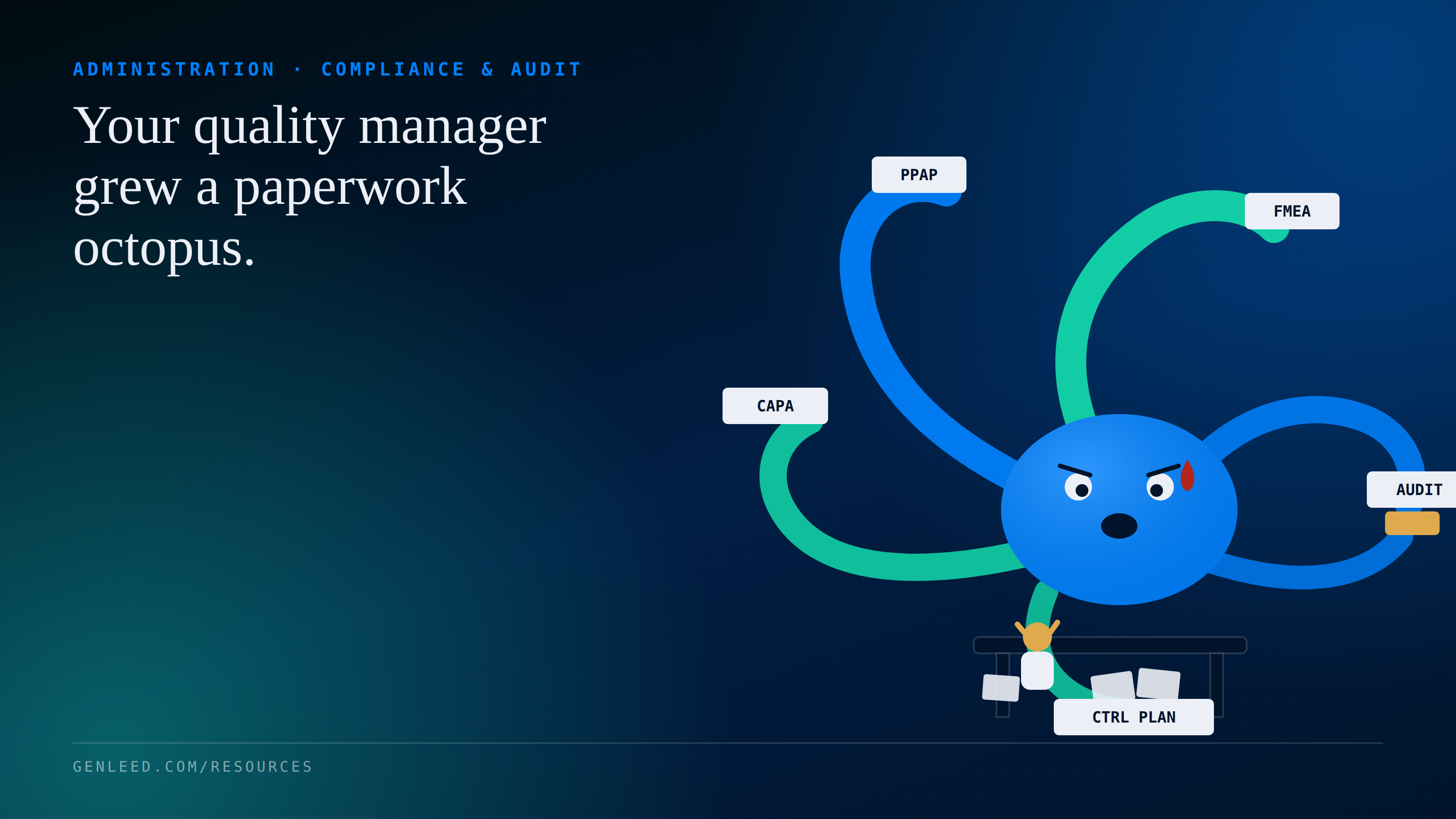
At a typical Tier 1 supplier, the quality manager can lose four to six hours of a day to IATF 16949 paperwork. Chasing PPAP signatures, updating a control plan after an engineering change, and pulling together evidence folders before the next internal audit. None of that is what's written on the job description. It's the tax that comes with keeping the certificate.
Why it happens
IATF 16949 itself doesn't require a dedicated admin position, but the way most plants implement it usually creates one anyway. A few patterns show up again and again:
- PPAP packages built by hand for every part number and revision, with no shared template pulling from ERP or engineering data
- Control plans and FMEAs live in separate documents that don't update when an engineering change comes through, so someone retypes the same information twice
- Internal audit prep means physically gathering evidence, training records, calibration certificates, corrective action logs, from wherever each department happens to keep it
- Corrective actions get logged in one system and tracked to closure in another, so time goes into reconciling status rather than closing the loop
What it costs
The direct cost is hours, often close to a half or full headcount buried inside a quality role that's supposed to be doing supplier development or process improvement instead. The less visible cost shows up at renewal or surveillance audit time, when a scramble to reconstruct records signals to the auditor, and to the OEM, that the system runs on effort rather than process. That's usually what turns a minor finding into a major one.
Diagnose before you automate
Before assuming you need new software, it's worth spending a week tracing where the hours actually go:
- Track one full week of quality admin time by task: PPAP, control plans, audit prep, corrective action follow up, so you have real numbers instead of a guess
- Pick one recent PPAP submission and count how many times the same part data was typed into a different document or system
- Check whether your last three internal audit findings were about the process itself or about missing or late documentation. Those are different problems
- Ask whether corrective actions have a due date and an owner that anyone actually checks, or whether they're tracked by memory
Where automation helps, and where it doesn't
When it's a process fix
If the week long trace turns up duplicate data entry across documents that could pull from the same source, or a control plan that isn't linked to the part master, that's usually a configuration and ownership problem first. Consolidating templates, assigning a single owner per document, and agreeing on one place records live can close most of the gap for the cost of a few working sessions, not new software.
When it's worth automating
Where automation earns its keep is routing and consolidation. Auto populating PPAP forms from ERP and engineering data instead of retyping them, routing corrective actions to an owner with an automatic due date escalation, and pulling audit evidence into one folder as records are created rather than the week before an audit. None of that needs to be called AI, it's closer to plumbing, moving data that already exists into the place it's needed on a schedule a person doesn't have to remember.
The takeaway
IATF 16949 documentation will always take real time. The question worth asking isn't whether to get it to zero, it's whether the current hours go toward genuine compliance work or toward retyping the same part number for the fourth time this month. Usually it's a mix of both, and the second part is the one worth fixing first.